Blockchain-based Signature Protocol
Connecting Ethereum to Tezos with a fast, transparent, and secure blockchain-based signature protocol.
Introduction
Cross-chain communication between Ethereum and Tezos requires a reliable and transparent signature protocol to ensure the integrity of asset transfers. Traditional systems relying on IPFS, IPNS, and centralized indexers have shown limitations in speed, availability, and observability.
To address these challenges, we introduce a new signer infrastructure that leverages Etherlink, a fast and low-cost EVM-compatible blockchain, to publish and verify signatures on-chain. This system offers real-time access, full transparency, and dynamic signer management through a dedicated smart contract, removing the need for external indexing or unreliable storage layers.
By using Etherlink as the core publishing layer, this protocol ensures that every signature is instantly accessible, verifiable, and auditable—paving the way for a more secure, scalable, and decentralized bridge between Ethereum and Tezos.
Overview
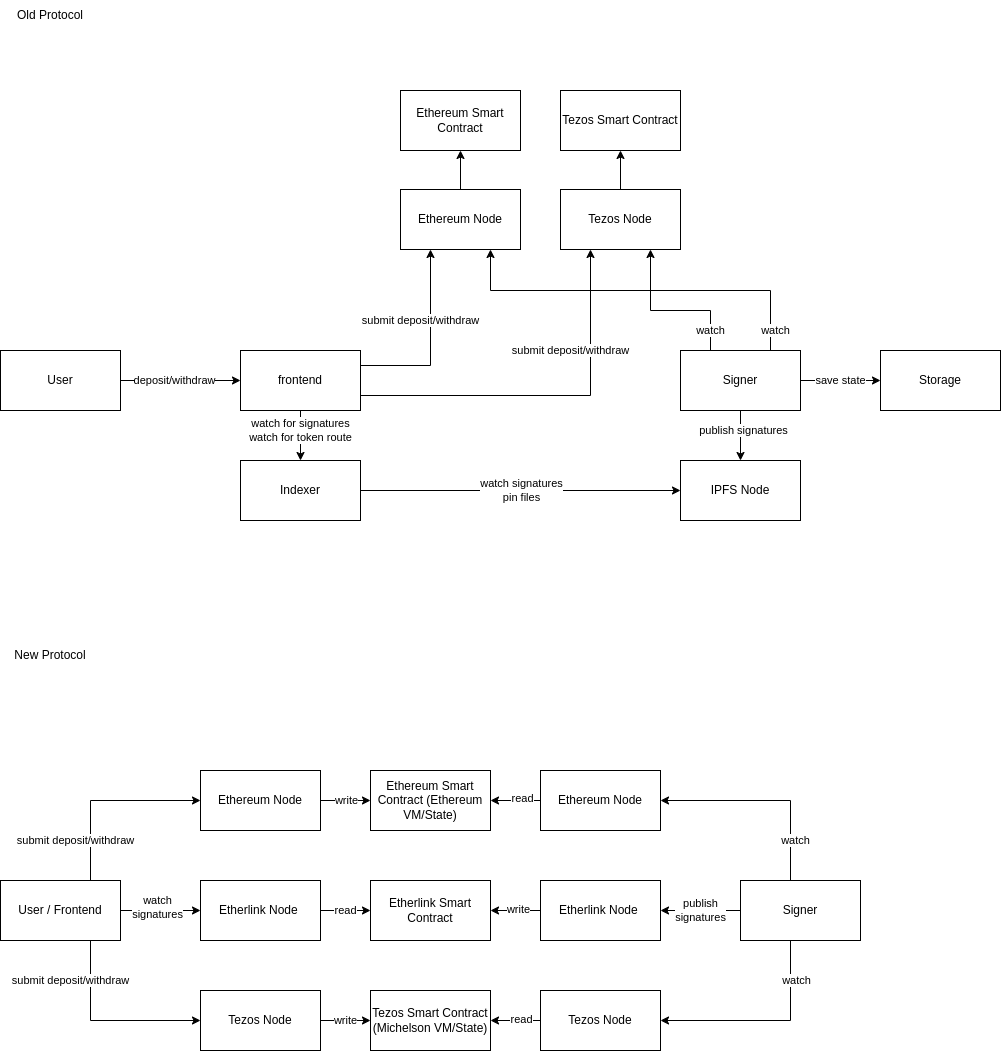
The new protocol introduces a simple, open-source signer that listens for events on both the Tezos and Ethereum blockchains, just like the previous setup. However, instead of relying on IPFS and IPNS to publish signatures, it now uses Etherlink, a blockchain known for its high speed, low cost, and excellent uptime. Using a smart contract on Etherlink, signers can publish their signatures in a transparent and publicly accessible way, removing reliance on slower or less reliable systems.
This design offers several key advantages over the old protocol. First, it eliminates the need for IPFS/IPNS, which were often slow and prone to availability issues. Etherlink's on-chain publishing ensures that signatures are immediately visible and permanently recorded, providing full transparency and verifiability. Unlike IPFS, where data might be lost or incomplete, using a blockchain guarantees data integrity and persistence.
In addition, the protocol enables real-time monitoring of signer performance. Slow or inactive signers can be easily detected and removed from the quorum, while high-performing nodes can be added dynamically. The use of Etherlink also removes the need for an indexer, simplifying integration. Instead of querying an external service, users can retrieve the latest signatures directly from the smart contract.
In summary, the new system provides superior speed, resilience, and flexibility compared to the old architecture. By eliminating IPFS and indexers, it resolves common issues like slow updates, limited observability, and static signer management. This design greatly improves the user experience and enables a secure, scalable, and decentralized bridge for blockchain event validation.
Comparison
| Advantages of the New Protocol (Signer + Etherlink) | Disadvantages of the Old Protocol (Signer + IPFS/IPNS + Indexer) |
|---|---|
| Full transparency with on-chain publishing on Etherlink | Lack of transparency: Signatures are stored off-chain in IPFS, making verification less straightforward |
| No dependence on IPFS and IPNS | Dependence on IPFS/IPNS: External systems that may be slow or unreliable |
| High performance and availability through Etherlink | Risk of delays and unavailability due to IPNS propagation |
| Easy signer addition/removal based on live performance | Rigid quorum management: Manual and less dynamic |
| No need for an additional indexer | Requires an indexer: Needed to collect and expose signatures to dApps |
| Public and direct access to signatures in a smart contract | Risk of incomplete indexing: Events or signatures might be missed or delayed |
| Dynamic and flexible quorum management via smart contract | Indexer is a central point of failure (SPOF) |
| Better resilience: No reliance on off-chain services | Risk of service downtime: If indexer goes offline, signatures become unavailable |
| Simpler integration: Just listen to smart contract events | Complex integration: Developers must handle multiple layers (signer + IPFS + indexer) |
| Real-time performance tracking of signers | Difficult to monitor signer performance in real time |
Comparison Summary
Advantages of the New Protocol
- Full transparency via Etherlink's on-chain data
- Simplified architecture with no external indexer required
- Higher reliability and performance, reducing delays and failure risks
- Dynamic signer management based on on-chain performance data
- Real-time monitoring and visibility of signer activity
Disadvantages of the Old Protocol
- Opaque signature validation through IPFS
- Dependency on slow/offline services like IPFS and IPNS
- Centralized indexer, prone to failure and difficult to scale
- Higher complexity in both integration and maintenance
- Lack of observability into signer performance or health
Performance
| Metric | Old Protocol (IPFS/IPNS + Indexer) | New Protocol (Smart Contract on Etherlink) |
|---|---|---|
| Signature publishing time | 5 to 30 seconds (IPFS upload + IPNS update) | ~1 to 2 seconds (transaction on Etherlink) |
| Network propagation | Several minutes (due to IPNS latency) | Instant (~2s block time on Etherlink) |
| Signature access latency | Depends on indexer sync (can be delayed) | Instant, via direct smart contract read |
| Publication reliability | Medium: prone to timeouts, network failures | Very high: ensured by blockchain consensus |
| Signer performance monitoring | Non-existent | Fully transparent and observable on-chain |
| Quorum update process | Manual, rigid | Dynamic and performance-based |
| Total time for usable signature availability | 10–60+ seconds (or longer with congestion) | 2–5 seconds (in most cases under 3s) |
Performance Summary
- Speed: On average, the new protocol is 5–10x faster.
- Reliability: Etherlink offers consistent uptime and delivery, reducing risks tied to IPFS.
- Real-time visibility: Signers' activity is fully observable on-chain.
- Simplified integration: No need for separate indexing or storage layers.
Conclusion
By leveraging Etherlink, the new protocol provides a fast, transparent, and reliable infrastructure for managing cross-chain signatures. It replaces fragile components like IPFS and indexers with on-chain smart contracts, improving performance and enabling dynamic signer management. This results in a more secure, scalable, and developer-friendly solution for bridging Ethereum and Tezos.